CR-39 Best Practices & Technical FAQ
How to Use CR-39 Nuclear Track Detectors
CR-39 (PADC) is a solid-state nuclear track detector that records charged particles — alphas, protons, heavy ions, fission fragments, and (indirectly) neutrons — with no power, no electronics, and no vacuum feedthroughs. This page answers the questions researchers actually ask before ordering: how CR-39 works, what it can and cannot detect, and how to handle, expose, etch, and analyze it.
Everything below is drawn from BlankSlate Innovation's own manufacturing and analysis experience and our peer-reviewed publications. If your question isn't answered here — because it needs simulation specific to your particle species, energy range, and geometry — that falls under paid consulting.
Quick reference
What CR-39 Can and Cannot Detect
CR-39 responds to particles above a threshold linear energy transfer (LET). Charged particles with enough LET leave a developable track; low-LET radiation leaves nothing.
| Radiation | Detected? | Notes |
|---|---|---|
| Alpha particles | Yes | Ideal above ~200 keV. Low-energy alphas are a challenge. |
| Protons | Yes | Good experimental experience from ~100 keV to 5 MeV. |
| Heavy ions | Yes | Above the LET threshold. |
| Fission fragments | Yes | Very high LET, easy signal. |
| Neutrons | Indirectly | Very low efficiency (~10-4–10-6); boron nitride coating boosts low-energy response. |
| Gamma rays | No | LET far too low — no track-creation mechanism. |
| X-rays | No | LET is far too low — no track-creation mechanism. |
| Electrons / beta | No | LET far too low. |
Detection threshold: ~0.8 MeV/(mg/cm²) in dE/dx, roughly 50–100 keV for most ions. The threshold is species-dependent.
What tracks look like
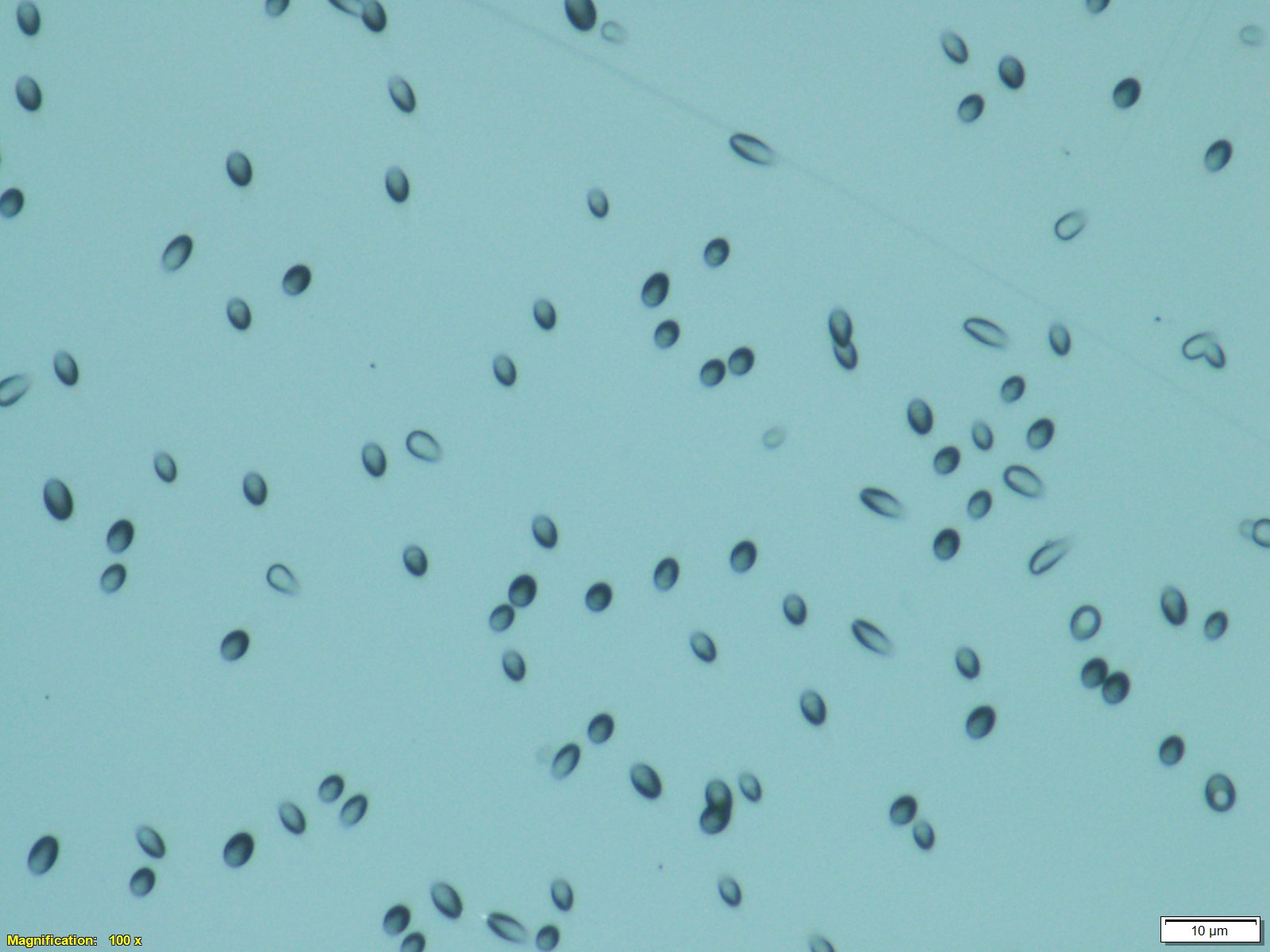
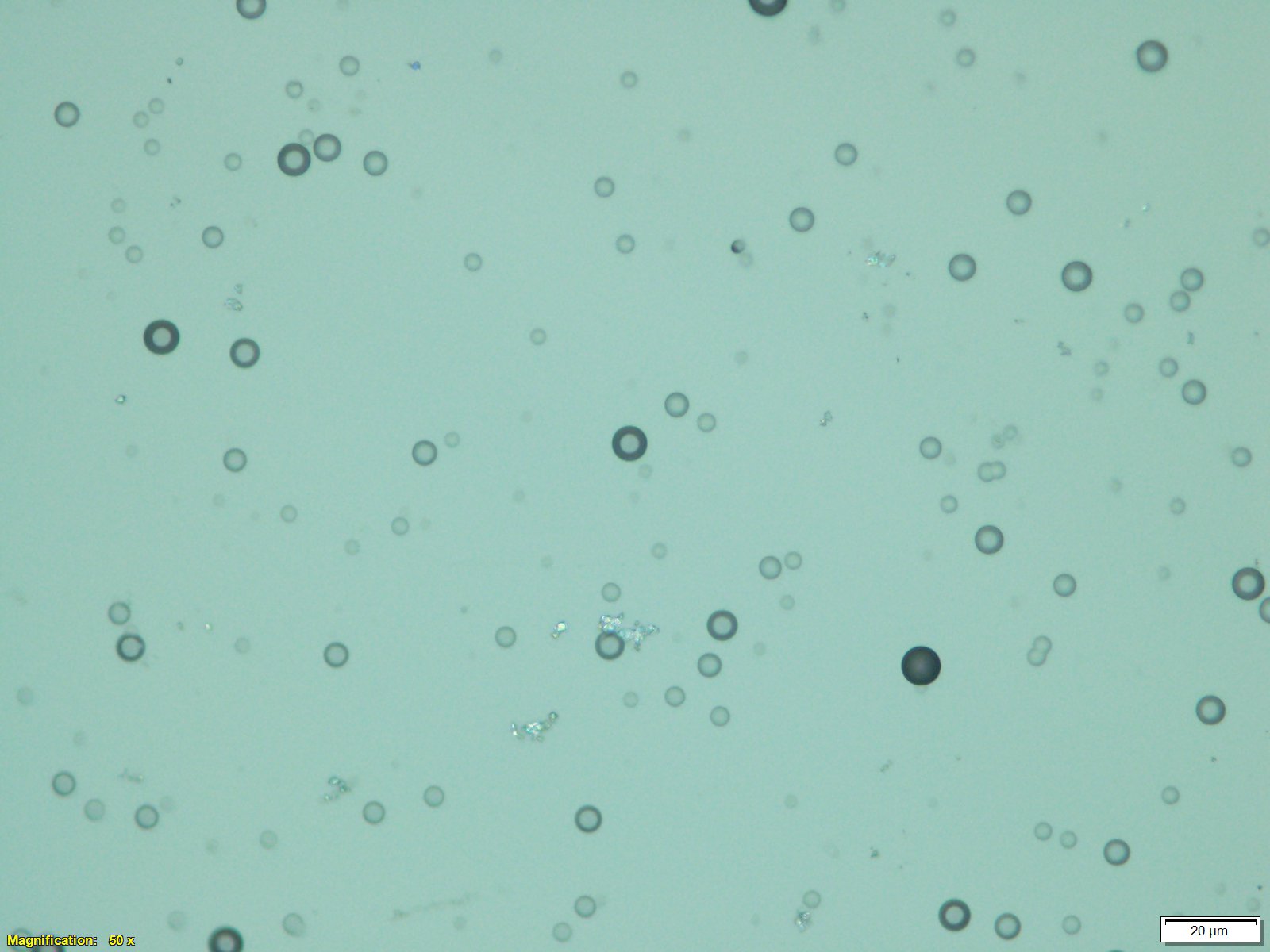
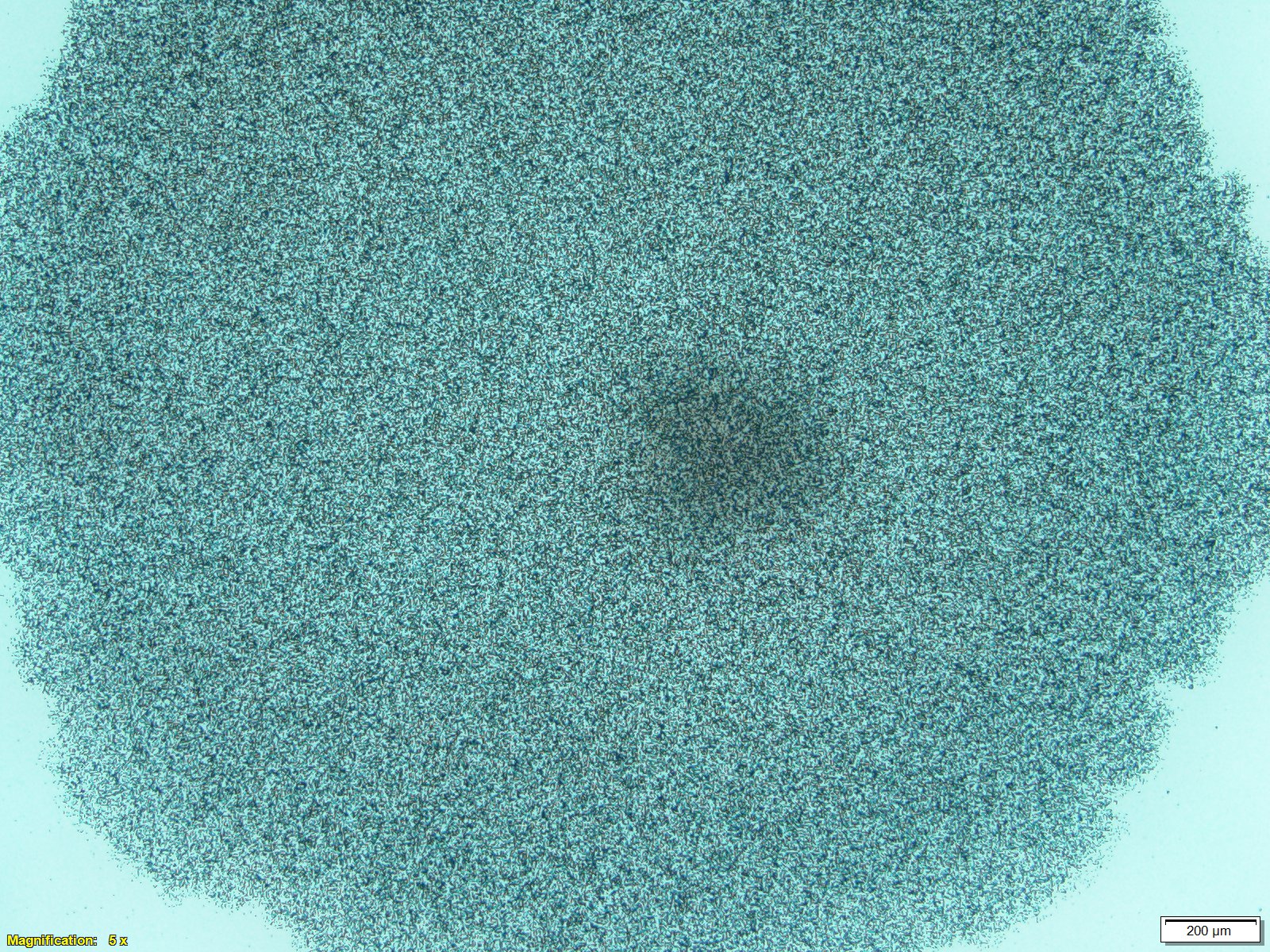
Etched Alpha Tracks in CR-39
Microscope images of BSI CR-39 after exposure and a standard NaOH etch. Track diameter relates directly to particle LET, so morphology carries energy information.

Frequently Asked Questions
CR-39 Best Practices FAQ
Click any question to expand the answer. This is the reference we route customers to when planning a CR-39 experiment. Questions not covered here typically require paid consulting, because answering them means running simulation and calibration specific to your setup.
How CR-39 Works
How does CR-39 work for nuclear detection?
CR-39 is a solid-state nuclear track detector made of PADC polymer. A charged particle passing through the plastic breaks chemical bonds along its path, leaving a latent damage trail. Etching in hot NaOH preferentially attacks the damaged material, opening the trail into a pit large enough to see under a microscope. The controlling parameter is linear energy transfer (LET): only particles above a threshold LET leave a developable track, and track diameter relates directly to LET. Detection is passive and cumulative, so CR-39 needs no power, readout electronics, or vacuum feedthroughs.
What is linear energy transfer (LET), and why does it matter?
LET is how much energy a particle deposits per unit path length as it slows down through electronic interaction with the polymer. Only particles above a threshold LET leave a developable track. Track diameter is directly related to LET through a function that can be determined for your conditions, and those numbers can be simulated — tools like SRIM are particularly useful and easy to use. This is why CR-39 gives you an LET measurement even in complex fields where species and energy are unknown.
Why does CR-39 need no power or electronics?
Because detection is passive and cumulative. The latent damage trail is stored physically in the plastic and developed later by chemical etching, so there is nothing to power, read out, or feed through a vacuum wall during the exposure. CR-39 records everything that hits it for the whole exposure, which makes it ideal for long-duration, high-vacuum, high-field, or space environments where active detectors are impractical.
What CR-39 Can and Cannot Detect
What radiation can CR-39 detect?
CR-39 directly detects alpha particles (ideal above ~200 keV), protons (good response from ~100 keV to 5 MeV), heavy ions above the LET threshold, and fission fragments (very high LET, easy signal). It detects neutrons only indirectly and with very low efficiency. It cannot detect gamma rays, X-rays, or electrons/beta, because their linear energy transfer is far too low to create a track.
Can CR-39 detect gamma rays, X-rays, or electrons?
No. CR-39 does not detect gamma rays, X-rays, or electrons/beta radiation. Their linear energy transfer is far too low to break enough chemical bonds to form a developable track. For gamma detection, a gamma spectrometer is the right tool; HPGe reaches nCi detection limits. For electrons, use a direct electron detector, or a secondary electron detector targeting under 50 eV for secondary electrons.
What is the detection energy threshold of CR-39?
There is a minimum energy below which an ion will not create a visible track. BSI's working threshold is about 0.8 MeV/(mg/cm²) in dE/dx, which for most ions corresponds to roughly 50–100 keV. Published values across the literature range 50–200 keV, varying with ion species and etching parameters. The threshold is species-dependent, so for an unusual ion such as argon BSI can give the range but not the exact value without simulation.
Experimentally pinning down the threshold for a new species is often a publishable result in itself, and at minimum worth emphasizing in the paper you're already writing — this is how CR-39 response curves get built up in the literature.
Can CR-39 tell one particle species from another in a mixed field?
Mixed radiation produces jumbled signal that is hard to unravel without controls on either particle type or particle energy. A 1 MeV alpha particle may look a lot like a 300 keV proton. If you do not know what species is hitting the detector, diagnosing its energy accurately is difficult; this is an active area of AI-driven research at BSI.
If your field is genuinely mixed and you need species discrimination, plan controls into the experiment — shielding variations, known-source calibration pieces, or geometry that constrains which particles can reach which detector.
Neutron Detection & Boron Nitride Coatings
Can CR-39 detect neutrons, and how efficient is it?
Only by proxy. Neutrons mostly pass through matter, but occasionally scatter elastically off a hydrogen, carbon, or oxygen atom in the polymer, and the recoiling ion leaves a track. Bare CR-39 neutron efficiency is on the order of 10-4 to 10-6 depending on energy — roughly 1 in 100,000 to 1 in 1,000,000 neutrons detected — with about 4 × 10⁻⁵ measured at 14 MeV.
What does a boron nitride (BN) coating do for neutron detection?
A boron nitride coating adds a 10B(n,α)7Li conversion layer, so neutrons that would otherwise pass through instead produce an alpha that the plastic registers. The efficiency gain is strongly energy-dependent and grows as neutron energy falls, because boron's capture cross-section rises steeply toward thermal energies. At 14 MeV BSI measured no efficiency gain from the BN coating. Full results are in section 3 of our BN coating paper.
How should I orient a BN-coated pane in a mixed ion + neutron field?
Face the uncoated side toward your experiment and the BN-coated side away from it. Neutrons pass through the plastic and reach the coating on the far side, while ions cannot penetrate to the back. You end up with essentially pure neutron signal on the back face, and negligible neutron signal buried in a large ion signal on the front face.
Are there special handling notes for BN-coated panes?
Yes. The coated side does not carry a protective PE film; the uncoated side does. The standard etching SOP applies to both coated and uncoated panes — gently rub the coated side while wearing nitrile gloves to remove the coating before etching. See our dedicated neutron-sensitized CR-39 page for more.
Material Specifications
What are the specifications of a standard BSI CR-39 pane?
| Property | Value |
|---|---|
| Nominal dimensions | 20 mm × 10 mm × ~0.75 mm (3 mm also standard) |
| Actual dimensions | 19.8 mm × 9.8 mm × 0.96 mm |
| Thickness variation | 0.8–1.0 mm |
| Density | 1.36 g/cc |
| Shore D hardness | 80.5 (range 80–83) |
| Typical Am-241 alpha track diameter | 2–5 µm |
BSI does not publish a conventional datasheet; our published papers serve that role and include tracks from 14 MeV neutrons, U-238 fission fragments, several alpha sources (Am-241, U-238, Po-210), boron neutron capture alphas, and Li-6 neutron capture (alphas and tritons).
Is CR-39 compatible with vacuum and cold temperatures?
Yes. BSI CR-39 is vacuum-compatible with no observed off-gassing, making it suitable for ultra-high-vacuum chambers and space payloads. Cold exposure is not a problem: -20 °C shows no track fading or sensitivity change, and BSI believes temperatures as low as -50 °C would be fine. Preliminary +100 °C testing showed no loss of signal, though pre-etch tracks enlarged roughly 2x over 10 days of continuous +100 °C exposure. Ask BSI for the current status of high-temperature testing if your application runs hot.
How much do panes vary batch to batch?
Thickness can vary between batches (for example 0.8–1.0 mm on mixed-batch orders). For most applications this is irrelevant, because analysis is reported as signal per unit area; tell us if uniformity matters to you. Humidity during manufacture affects quality, and thinner panes are more prone to cracking during production, so fulfillment times vary.
Sizes, Thicknesses & Custom Geometry
What sizes and shapes of CR-39 can I order?
Standard stocked panes are 20 mm × 10 mm, in ~0.75 mm or 3 mm thickness; everything else is made to order. BSI laser-cuts to order, and past orders include 1 cm × 1 cm, 1″ × 1″, 2″ × 2″, 20 cm × 10 cm, and 10–50 mm diameter discs. We also sell full sheets of roughly 26 cm × 26 cm for customers who want to cut their own. See the ordering page for sizes and lead times.
How thin can CR-39 be made?
BSI has manufactured 0.5 mm to 3 mm routinely. About 500 µm is achievable, though not as clean as standard thicknesses. About 100 µm is very difficult: we have produced it and gotten good tracks under a microscope, but at that thickness the material is dominated by electrostatic forces (it floats around and sticks to everything), is hard to cut cleanly, and will tear in your hand. It also needs a custom etching approach, so expect a significantly higher price per piece reflecting both the labor and the R&D to establish the process.
How big does my detector actually need to be?
There is usually no reason to use a large surface area. Analysis cost and runtime scale with area, and signal is typically homogeneous across a pane, so a ~1 cm² region of interest is enough. Larger pieces mostly buy you spares and handling margin, not data. Dimensional tolerance of ±1 mm is fine for most experiments because analysis is reported as signal per unit area; tell us if you need tighter.
Shipping, Storage & Shelf Life
How should CR-39 be stored, and what is its shelf life?
Store CR-39 at room temperature or refrigerated, away from prolonged direct sunlight, and somewhere ventilated so background radon does not accumulate extraneous signal. Cryogenic storage is not necessary for BSI material; we have seen no evidence of latent-track self-healing. BSI has not run a formal lifetime study, but expect possible sensitivity loss after 6–12 months. Anecdotally, an 18-month-old pane that would normally give ~5 µm track diameters in QC yielded ~1 µm.
Do I need cryogenic storage to prevent track fading?
No. Some groups insist on storing CR-39 under liquid nitrogen before and after exposure, on the theory that cold prevents the plastic from "self-healing" latent tracks. BSI has seen no evidence of self-healing in the CR-39 we produce, so cryogenic storage is not necessary for our material. This may be a manufacturer-to-manufacturer difference.
Does air shipping add background from cosmic rays?
BSI ships ground where possible to reduce tracks from cosmic radiation and radon during transit. We have not extensively tested air shipping for noise contamination, but it appears low. If your experiment is low-signal and your shipment flew, treat a background control pane from the same batch as mandatory. Panes ship wrapped in aluminum foil inside a vacuum-sealed bag, each carrying a protective PE film on both sides.
Handling, Cleaning & Mounting
How do you handle CR-39 without damaging it?
Wear nitrile gloves and remove the protective PE film from both faces before exposure by lifting a corner with a fingernail or tape. Grip the edges with tweezers where possible; smooth steel tweezers on the face are acceptable and any scratch is easily distinguished from tracks under a microscope. Mark the unexposed face by scratching a number into it, not with marker, because hot lye etch removes ink. Do not ultrasonicate; if cleaning is needed, soak or wash gently with DI water or 90% isopropanol.
How do I remove the protective film?
Both faces of an uncoated pane carry a PE film that must be removed before exposure (BN-coated panes have film on the uncoated side only). There is no adhesive — the only stickiness comes from the laser cut. Wear nitrile gloves and lift a corner with a fingernail; picking at the edges usually gets it started, and tape also works. Note that washing tends to detach the film, so wash after removal, not before.
How do I mark which face was exposed?
You need a way to tell exposed from unexposed after the fact. Scratch a number into the unexposed face. Do not rely on marker — ultrafine Sharpie survives handling but is removed by the etch (hot lye). After etching, the only indicator of exposure is the tracks themselves under a microscope.
Do I need to clean CR-39 before use?
Laser cutting leaves a light oily residue that has never been a problem in ultra-high vacuum; BSI's own prep is to put panes in a vacuum chamber to drive off volatiles. If the CR-39 will contact biological media, soak or wash (do not scrub) with DI water or 90% isopropanol. Do not ultrasonicate — in our experience it makes things worse by scratching the surface or concentrating debris. If nothing in your setup is harmed by the residue, we recommend cleaning nothing at all, since every extra step raises the chance of debris or scratches on the surface you're about to image.
How do I mount a pane in my setup?
Use double-sided tape on the back face to stick the pane to something behind it, ordinary tape to attach the pane directly to a sample, or a 3D-printed holder for more demanding geometry. There is no single right answer — get creative.
The Quality-Control Pane
What is the QC pane that ships with my order?
Every order ships with a QC pane so you have a known-good reference to compare your etched samples against. It is exposed to ~1 µCi Am-241 alphas at ~5 mm standoff in air (~680 torr) for ~2 minutes (we may reduce the irradiation time, and will inform you), then etched per our standard SOP (6.25 M NaOH, 80 °C, 1 hour). Typical resulting track diameter is 2–5 µm.
Which face of the QC pane was exposed, and what is the indentation?
The exposed face is opposite the scratched face — the scratch marks the unexposed side. There is an indentation near the center of the exposed face; that is from Shore D hardness testing (80.5, typical of our material), not from the exposure.
Etching
How do you etch CR-39?
BSI's standard etching SOP is 6.25 M NaOH at 80 °C for 1 hour, shipped with every order and used for all published work, requiring only a hot plate and a Teflon beaker. The conditions are largely arbitrary and can be tuned: across the literature labs run CR-39 etching anywhere from 12 minutes to 36 hours, 3 M to 8 M NaOH, and 60 °C to 100 °C. Longer, hotter etches enlarge tracks (helpful for marginal signal) at the cost of surface quality and dimensional stability. Boron-coated panes etch under the same SOP.
How long does etching take, and can I parallelize it?
Etching is not labor-intensive — start it, set a timer, and go do something else — but it is serial per beaker. If you use 10 panes per experiment, that's 10 hours of etching unless you parallelize. Multiple hot plates and multiple Teflon beakers run simultaneously; that's what BSI does.
Does the standard etch work for very thin panes?
The standard SOP is probably not sufficient below roughly 500 µm. You (or we) will likely need a Teflon holder to constrain the piece during etching and prevent the plastic from distorting, and that needs QA testing before you commit real samples to it.
Should I etch samples myself or send them to BSI?
Either works. If you etch yourself, you can inspect on your own microscope before deciding what to send us — the safer route if you aren't yet sure your samples carry appreciable signal. If BSI etches, results are usually cleaner for our own analysis, but you lose that check. We do not recommend shipping a batch of un-etched samples for costly analysis when nobody has confirmed there's signal on them.
Analysis: Optical vs. SEM + AI
What is the best way to analyze CR-39 tracks?
Optical microscopy gives accurate track counts and some species differentiation when signatures differ strongly, and is fine for preliminary study. For any publishable dataset BSI uses SEM large-area mapping with AI analysis, which adds track number, angle of arrival, ion-species differentiation, neutron-versus-ion discrimination, and a rough energy spectrum. A recommended scan area of 0.2 cm² is typically enough for statistically significant data. The practical track-density ceiling is 20–50 million tracks/cm² before overlap degrades the automated count. See our automated AI track analysis page.
Can I just use an optical microscope?
Yes, and for preliminary study that's what BSI uses internally too. Optical microscopy gives highly accurate track counts and some ion-species differentiation, provided the species produce significantly different track signatures — argon vs. protons is easy, oxygen vs. carbon is hard. If your track density is high (say 10,000 tracks/mm² or more), a single 1 mm² optical field may be all the data you need. We can also take optical images and send them to you for your own manual analysis.
What does SEM + AI analysis add over optical?
SEM large-area mapping with AI is BSI's better method and what we use for any publishable dataset. It supports track number, angle of arrival, ion-species differentiation, neutron-vs-ion discrimination, and a rough energy spectrum. An SEM is required for our AI analysis and, in our opinion, for any rigorous analysis. The methodology is documented in our peer-reviewed AI track analysis paper. If you only have an optical scope, you can still get useful preliminary data and then send selected panes to us.
What if my track density is too high or too low?
Above roughly 20 million tracks/cm² the AI begins to struggle with overlapping tracks; 20–50 million tracks/cm² is the practical ceiling. Overlap can be partially corrected by manually assessing the miss rate on a subsample (inspect e.g. 5,000 tracks, count how many were missed to overlap) and scaling the automated count accordingly. For low signal, if your source is steady, deliberately over-expose the CR-39 and scale the result back down linearly — expose for 20 minutes instead of 10, then divide by two for the same answer with better statistics.
Can I get my samples back after analysis?
Yes, but they come back metalized with a thin iridium layer applied for SEM. BSI has not tried removing it; the most promising approach is probably a high-tack tape lift followed by surface cleaning. No chemical process will remove iridium without damaging the plastic, as far as we know. If de-metalization matters to your workflow, tell us up front and we can test it.
Beyond the FAQ
What Requires Paid Consulting
The FAQ above is BSI's free CR-39 reference — the answers to common questions are all here. If your question isn't covered here, answering it requires real simulation and calculation specific to your experiment. We are happy to provide this service to help set up your experiment, but we bill it as consulting. When you ask a question, we will estimate the time required and issue an official quoted price. Email confirmation constitutes acceptance of that quote and commits you to payment after we deliver the consulting, whether or not you proceed with a CR-39 order or experiment.
Consulting is billed at $100/hr and can be bundled with a CR-39 order. Every consulting email notes how long the drafting, calculation, simulation, and research took for the work in that email, so costs never run away from you without your knowledge. For projects where we'd be contributing genuine scientific input rather than a service, we're also open to a mutually-beneficial collaboration agreement instead — co-authorship on resulting publications in lieu of fees.
A note on timelines: CR-39 itself is cheap. If you're on a deadline, order the plastic now in a reasonable configuration and work out the analysis details during your exposure period. You do not need the full experimental design settled before buying detectors, and there is often ample time to nail down calibration while your samples accumulate signal.
What CR-39 questions require paid consulting from BSI?
The questions answered on this page are BSI's free CR-39 reference. If your question isn't covered here, we charge for the response, because answering it requires real simulation and calculation specific to your experiment: stopping-range and energy-deposition simulations for your species and energy range, calibration and LET-response curves for species outside the directly measured proton and alpha range, detailed stack design (layer count, thickness schedule, filter selection, uncertainty budget), track-density and saturation calculations for a specific mission profile, and qualification testing for flight or regulated applications. Consulting is billed at $100/hr and can be bundled with an order, or replaced by a mutually-beneficial collaboration and co-authorship agreement.
Stopping-range and energy-deposition simulations for your particle species and energy range.
Calibration curves and LET-response data for species outside our directly measured range (proton and alpha data from ~100 keV to 5 MeV; everything else simulated, typically within 10–20% error).
Detailed stack design: layer count, thickness schedule, filter selection, and expected uncertainty budget.
Track-density and saturation calculations for a specific mission profile, and qualification testing for flight or other regulated applications.
Get started
Order CR-39 or Book a Consultation
Order detectors and analysis directly, or book a consulting engagement for the simulation, calibration, and experiment design that fall outside the FAQ above.
Related: CR-39 product overview · automated AI track analysis · passive neutron detection · published research