CR-39 for Nuclear Particle Track Detection
The thermoset polymer, CR-39, is used in nuclear particle tracing and calorimetry as a solid state nuclear track detector (SSNTD). When a high energy particle impacts the polymer it breaks bonds and allows for preferential etching during post-exposure processing. These etched tracks can then be observed and characterized under a microscope.
Thermal/epithermal neutrons can be detected by coating CR-39 with boron to produce the 10B(n,a)7Li reaction and subsequent alpha-particle detection. Boron-coated CR-39 is manufactured by BSI for neutron detection applications — see our published work on boron nitride coatings for CR-39. For a full discussion of passive neutron measurement with CR-39, visit our neutron detection page.
This SSNTD has a wide variety of applications of radiation measurement, including home radon detection, dosimetry, and is a less visceral display of radiation damage for educators. University instructors can review our CR-39 for teaching labs page for class-set ordering and undergraduate experiment ideas. Federal and defense buyers can read why BSI is the US radiation-grade CR-39 supplier.
Click here for more information for best practice for the use of CR-39.
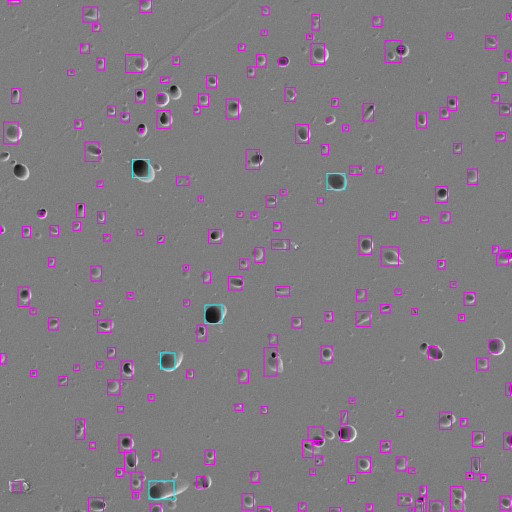
Click here for electron microscope web application image. This image is of our CR-39 exposed to Am-241 alpha particles. Notice the direction of impact and depth of penetration. Here is the same image with AI labeling of features. Here is an image of U-238 fission fragment tracks boxed in cyan. Our methodology for SEM large-area mapping and AI-driven track analysis is detailed in our peer-reviewed paper on AI analysis of CR-39 with SEM large area mapping.
Particle Track Images
Microscopy Examples
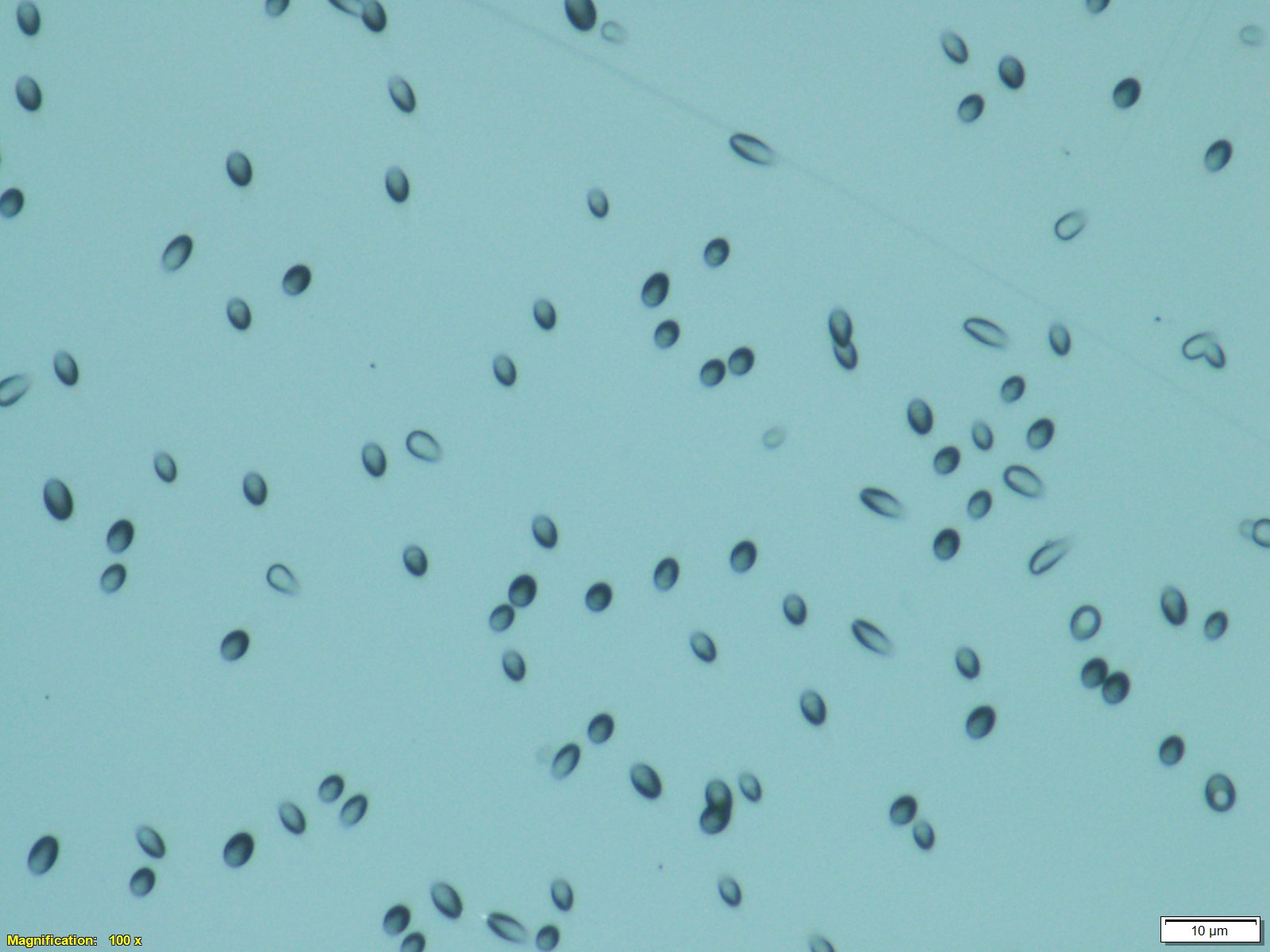
5.5 MeV alpha particles striking the CR-39 from various angles.
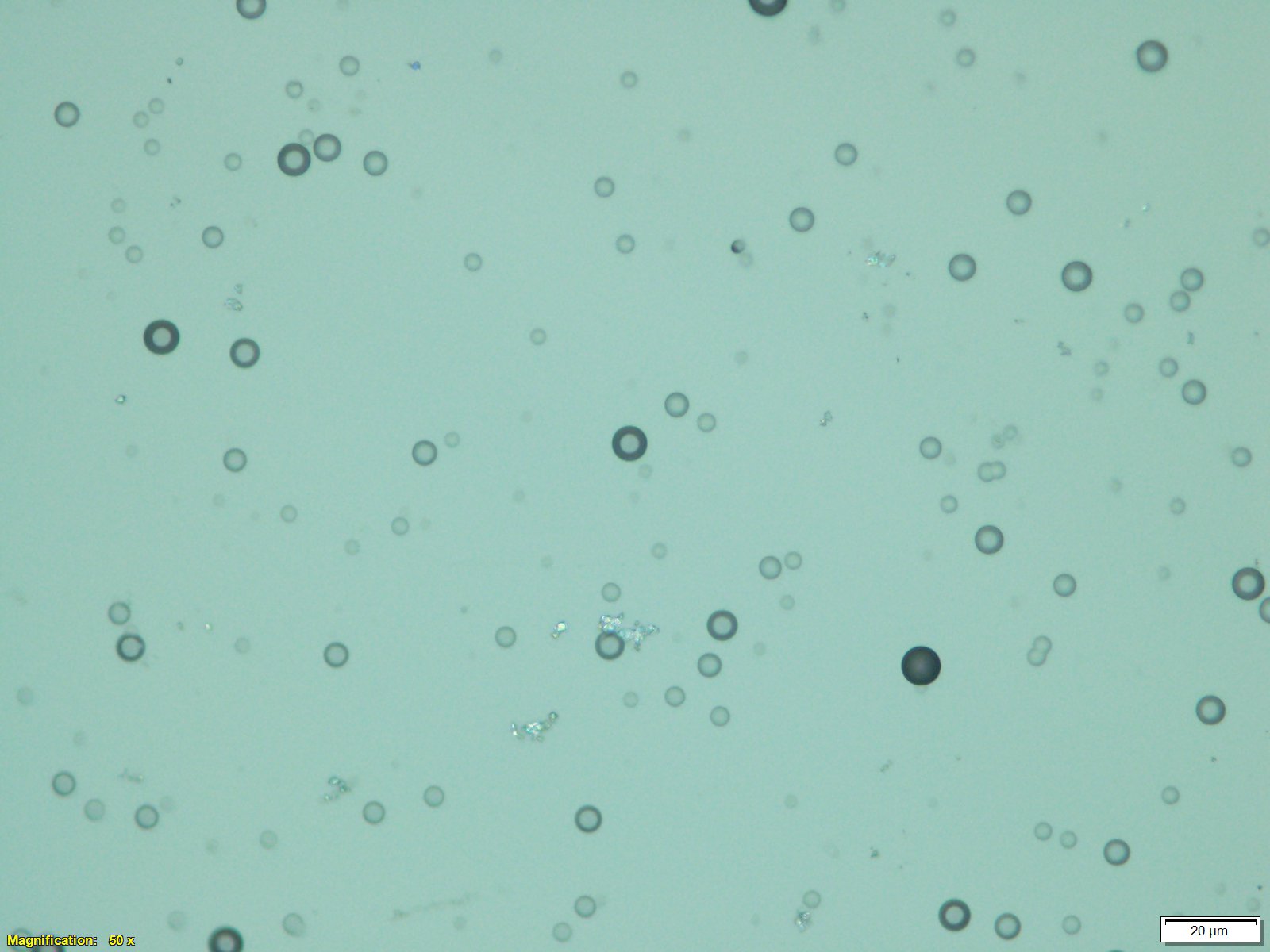
5.5 MeV alpha particles with energies moderated by passing through graphene aerogel.
SEM image of 14 MeV neutron-induced proton-recoil (magenta) and U-238 fission fragment (cyan) with AI detection.
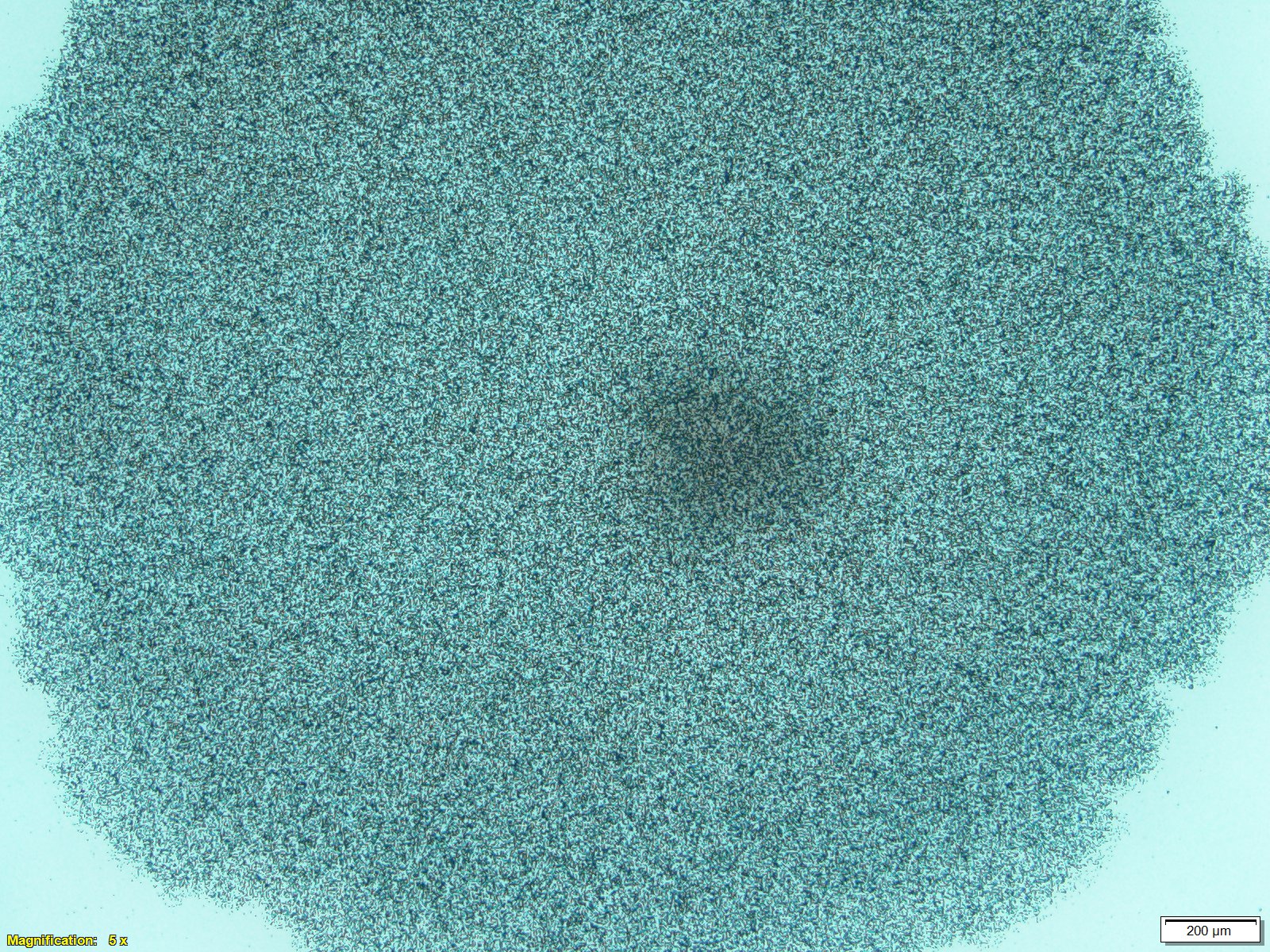
Overexposure of CR-39 to alpha particles.
The US radiation-grade CR-39 supplier
BlankSlate Innovation supplies radiation-grade CR-39 (allyl diglycol carbonate, also called PADC) track detectors from the United States, for buyers who cannot treat detector supply as a generic overseas commodity purchase. We cast, cut, polish, and — when required — boron-coat every chip in-house in Lubbock, Texas, so federal, defense, national-lab, and university programs work with a US-based technical team from quote to delivery.
Every batch is checked for optical clarity and thickness uniformity before it ships, and the same team that makes the detectors runs the SEM large-area mapping and AI track analysis, so exposure, etching, and readout stay accountable to one source. Standard orders ship in as little as 3 business days; large orders take up to 4 weeks.
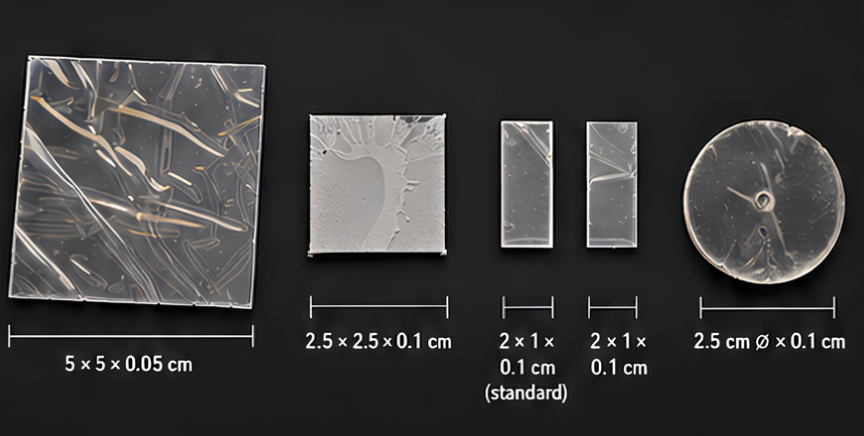
Custom Manufacture and Dimensions to Fit Your Needs
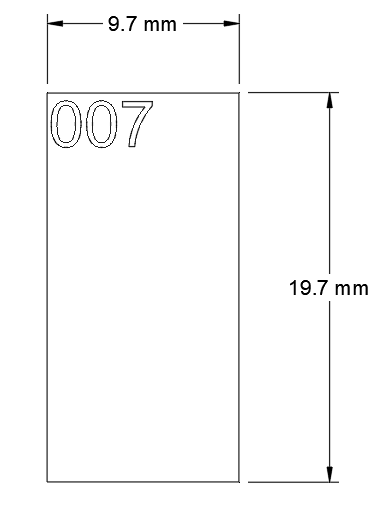
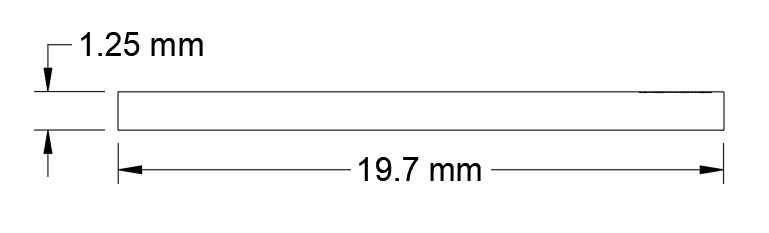
These views show BSI's standard manufacturing dimensions for CR-39, which can be adjusted to fit application-specific detector geometry.
Applications
CR-39 Products & Kits
Education
Learning Radiation Kit
See the effects of radiation with your own eyes. Expose CR-39 to alpha particles from thorium-tungsten rods and observe particle tracks, energies, and directions — with the unaided eye or under a microscope.
View Kit — $100Environmental Testing
Radioisotopes in Water Test
A simple, inexpensive test for alpha-emitting radioisotopes in drinking water. CR-39 detectors are exposed to your water sample and analyzed to produce a confidential report with risk-level guidance.
View Test Kit — $60Services
SEM Large Area Mapping & AI Analysis
End-to-End CR-39 Workflow
From experiment design to AI-labeled tracks.
BSI helps researchers extract the maximum value from CR-39 detectors at every stage of the workflow — whether you want to run the experiment yourself with our guidance, or ship exposed chips back to us for full SEM imaging and AI analysis.
Consulting & Guidance
Experiment design. We help you set up exposures, geometries, and shielding to capture the cleanest data for your particle type, energy range, and source strength.
Etching procedures. Optimize NaOH concentration, temperature, and etch time for your application — alpha tracks, fission fragments, proton recoil, or thermal neutron capture via boron-coated chips.
Imaging consult. We advise on optical and electron microscopy procedures, magnification, contrast, and tiling strategies to produce reliable large-area maps.
Ship-Back Analysis Service
Send your exposed CR-39 chips to BSI and we handle the rest. Our SEM large-area mapping pipeline combined with the AI-driven track classifier delivers:
- ■Particle count and flux across the full chip area, not just sampled fields of view.
- ■Particle species — alpha, proton recoil, fission fragment.
- ■Energy and LET distributions from track diameter, length, and morphology.
- ■Angle of arrival for each particle.
- ■Raw data from the track images, for your own analysis.
- ■Source vs. noise discrimination to separate genuine particle tracks from polishing artifacts and surface contamination.
Turnaround: 10–30 days, depending on complexity and number of samples. Quoted per project.
Methodology validated in our peer-reviewed work: AI analysis of CR-39 with SEM large area mapping.