BlankSlate Innovation — Natural Gas
How Much Helium-3
Is Hiding in Your Natural Gas?
At just 50 parts per billion, helium-3 in your natural gas stream doubles the economic value of your well. At current market prices exceeding $18 million per kilogram, even trace concentrations represent significant untapped revenue. The problem: almost no one has tested for it.
The Math That Changes Everything
Natural Gas
Approximate value of one MCF (1,000 cubic feet) at the April 2026 Henry Hub benchmark. This is the commodity you sell today.
Helium-3
Conservative value of one MCF of pure He-3 at ~$2,000/liter. Market pricing ranges $1,000–$20,000/L depending on source and subsidy; BSI quotes the conservative midpoint.
How Trace Concentrations Reshape Well Economics
| He-3 Concentration | Added Value per MCF | Well Value Multiplier |
|---|---|---|
| 10 ppb | $0.57 | 1.2× |
| 25 ppb | $1.43 | 1.5× |
| 50 ppb | $2.85 | ~2× |
| 100 ppb | $5.70 | ~2.9× |
| 200 ppb | $11.40 | ~4.8× |
Assumes $3/MCF Henry Hub benchmark and $2,000/L He-3. 1 MCF = 28,317 L. Multipliers are incremental on top of existing natural gas revenue.
Pulsar Helium’s Topaz Project — Minnesota
In October 2025, Pulsar Helium publicly reported He-3 concentrations of up to 14.5 ppb at their Jetstream #1 well. The discovery was confirmed by four independent laboratories, including the USGS Noble Gas Lab and Lawrence Livermore National Lab.
At ~$2,500/liter, this He-3 content represents meaningful incremental value on top of an already high-grade 8% helium-4 reservoir. It is among the highest naturally occurring He-3 concentrations ever publicly reported from a terrestrial gas reservoir — comparable to estimated concentrations in lunar regolith, which NASA is spending billions to develop extraction technology for.
The question for every other operator: what’s your number?
Most of America’s Natural Gas Has Never Been Tested for Helium-3
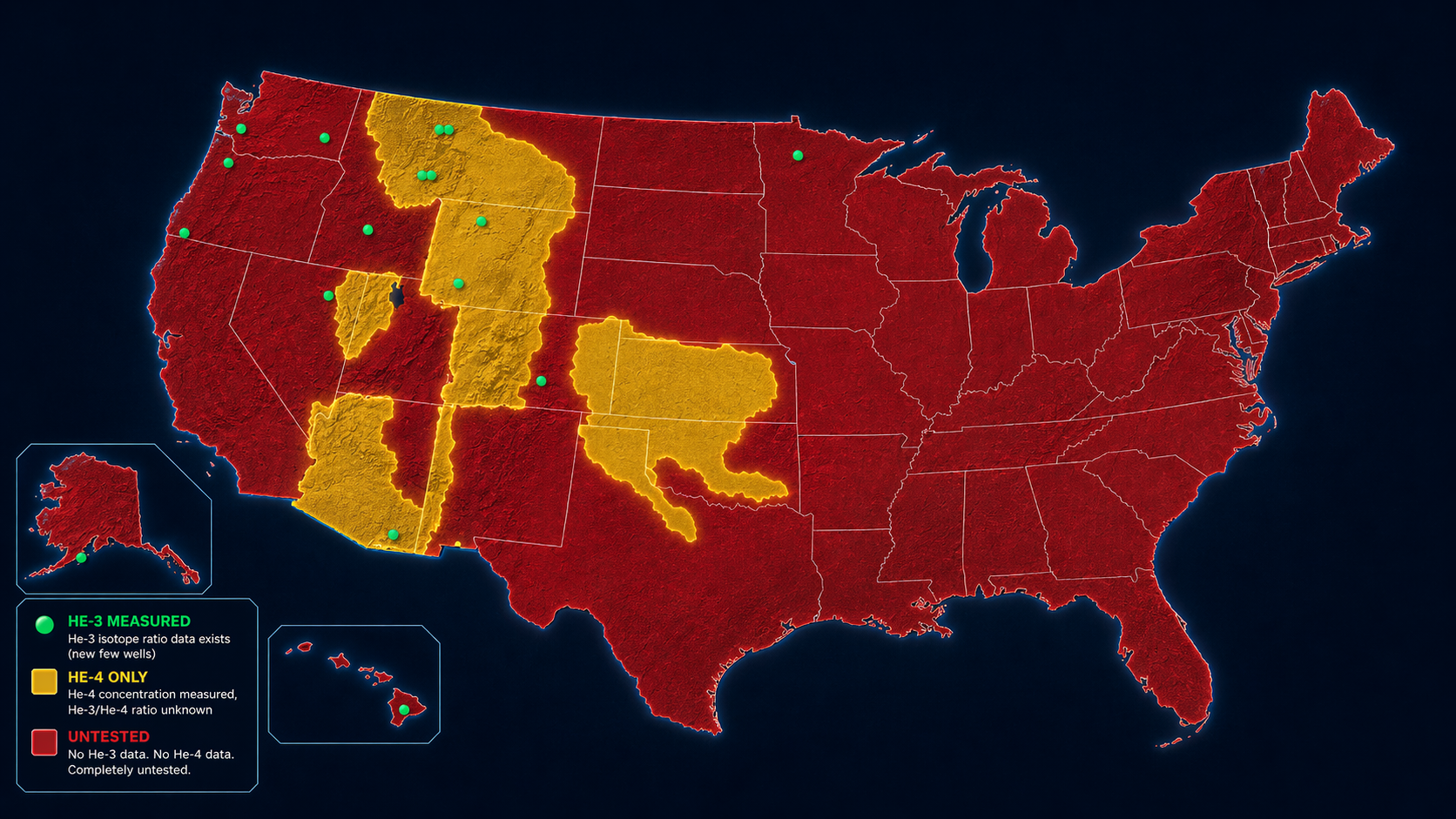
Helium-3 is so valuable that NASA and the US Government are actively funding lunar mining missions to extract it from moon dust at concentrations of 1.4–15 ppb. Meanwhile, >99% of terrestrial natural gas wells that may contain similar or higher concentrations have simply never been tested.
The USGS Federal Helium Program has tested approximately 3,100 gas samples across ~480 reservoirs for helium-4 content. But He-3/He-4 isotope ratio measurements — the data needed to quantify He-3 — have been performed on an extremely small number of these wells. Entire major basins producing billions of cubic feet of natural gas annually have zero He-3 data.
Until recently, testing capacity for this measurement was scarce and hard to access. That’s changing. BSI operates a noble gas isotope analysis lab for natural gas samples that accepts samples directly from operators. Read our detailed guide on He-3/He-4 isotope ratio analysis, review our helium exploration for oil and gas overview, or see how a helium resource assessment grades a play.
306 BCF
of recoverable helium exists in known US natural gas reservoirs (USGS, 2021). The He-3 fraction of this helium is almost entirely uncharacterized.
Send Us a Gas Sample
BSI operates a noble gas isotope analysis lab that accepts natural gas samples directly from operators. We report your He-3 concentration with quantitative accuracy down to 0.5 ppb, along with the ³He/⁴He ratio.
1 sample
$200
A single spot check of your gas stream.
3 samples
$500
Test multiple wells or production points in one submission.
7 samples
$1,000
Collected across multiple days to average out day-to-day variation in well output — a statistically representative result. Contact us for bulk rates above 7 samples.
Results are typically returned 2–4 weeks from when we receive your sample. See our noble gas isotope analysis lab page for full pricing and turnaround details.
From Sample to Strategy
1
Send a Sample
Send us a gas sample from your well — we recommend 7 samples across multiple days for a statistically representative result. We measure He-3 concentration and return quantitative results in 2–4 weeks from the time we receive the sample.
2
Economic Analysis
If your He-3 is economically interesting, we provide a detailed analysis: estimated yield per unit production, projected annual value, and breakeven for separation infrastructure.
Complimentary3
Extraction Consultation
If the economics justify it, we consult on He-3 extraction infrastructure: full separation systems, bolt-on manifolds downstream of existing cryogenic processing, or custom engineering for your facility.
4
Ongoing Monitoring
For ongoing production, we can discuss on-site monitoring for continuous He-3/He-4 ratio tracking and QA during extraction, across all of your wells.
No data-sharing requirement. Your concentration data remains confidential unless you elect to share it.
Why So Few Wells Get Tested
Most facilities capable of He-3/He-4 isotope ratio analysis are academic or federal research labs, not commercial service providers set up to take samples from operators. Access to that capability is typically through a research collaboration, not a purchase order — which is a large part of why so much of the country’s natural gas has simply never been checked for He-3.
BSI’s noble gas isotope analysis lab exists to close that gap for operators. See that page for what we measure, why the analysis is hard to come by, and how to submit a sample.
The Helium-3 Market Is Moving. Are You?
Quantum computing demand is surging.
Dilution refrigerators — the cooling systems quantum computers depend on — require He-3. The world’s leading manufacturer, Bluefors, signed a $300M prospective deal with Interlune for lunar He-3 supply. Large-scale quantum computers may require tens of thousands of liters per machine.
The US stockpile won’t last.
The DOE’s He-3 stockpile is roughly 90,000 liters, primarily sourced from tritium decay in aging nuclear warheads. US annual production is only ~8,000 liters. Demand is about to far outstrip supply.
Lunar mining is being funded — seriously.
NASA and the US Government are actively funding helium-3 extraction from lunar regolith, where concentrations average ~4 ppb. Interlune and others have raised hundreds of millions. If He-3 at 4 ppb is worth going to the Moon for, what’s He-3 at 10–50 ppb in your well worth?
Terrestrial sources are the near-term answer.
You don’t need a rocket. You need a mass spectrometer. The He-3 may already be flowing through your infrastructure — you just haven’t measured it.
Questions We Hear From Operators
How do I collect a sample?
What if my He-3 concentration is too low to be economical?
Can you support ongoing monitoring across multiple wells?
How does He-3 extraction actually work?
Is this real? He-3 from natural gas sounds too good to be true.
From $200 — 2–4 Week Turnaround
Find out if your natural gas is hiding the most valuable isotope on Earth.
Submit a sample request below and a BSI engineer will reach out within one business day with sampling instructions and a shipment label.
Sample Request
Reach out for a sample analysis.
Describe the basin, whether you already have a gas sample, and anything important about timing, production conditions, or current helium data.