CR-39 · Fusion Diagnostics
CR-39 FOR
FUSION DIAGNOSTICS
CR-39 (also written CR39) is a passive plastic track detector that records the protons, alphas and tritons a fusion reaction produces, and the fast neutrons it releases through proton recoil. No power, no electronics, and no response to X-rays, gamma rays or electromagnetic pulse. BSI supplies radiation-grade chips and reads them out with SEM large-area mapping and AI track classification.
What It Measures
What CR-39 records in a fusion experiment
When a heavy charged particle hits CR-39 it breaks polymer bonds along its path. Chemical etching turns each damaged path into a pit you can image, count and measure. Fusion experiments give it three jobs:
Charged fusion products
Protons, alphas and tritons from DD, DT and D-He3 reactions leave direct tracks. Track diameter and depth carry the particle's energy, so a filtered chip becomes a simple charged-particle spectrometer.
Fast neutrons
Neutrons leave no direct track, but they knock protons out of the hydrogen in the polymer. Those recoil protons etch into tracks. BSI has recorded 14 MeV neutron-induced proton-recoil tracks in its CR-39.
A quiet detector in a noisy shot
Pulsed fusion devices flood electronics with X-rays and EMP. CR-39 ignores both, so the tracks reflect particles, not background.
Reaction Products
Fusion reactions and what CR-39 sees
Product energies are standard textbook values. Which ones you can use depends on your target, filtering and exposure geometry.
| Reaction | Charged product(s) | Neutron | How CR-39 records it |
|---|---|---|---|
| D + D → T + p | 3.0 MeV proton, 1.0 MeV triton | — | Direct tracks from the proton and triton |
| D + D → 3He + n | 0.8 MeV 3He | 2.45 MeV | Direct 3He track; neutron through proton recoil |
| D + T → 4He + n | 3.5 MeV alpha | 14.1 MeV | Direct alpha track; 14 MeV neutron through proton recoil |
| D + 3He → 4He + p | 3.6 MeV alpha, 14.7 MeV proton | — | Direct tracks from both products |
In the neutron-producing branches, CR-39 sees the neutron only through proton recoil in the polymer. For thermal and epithermal neutrons from moderated sources, a boron-coated chip adds a capture channel.
Readout
From exposed chip to a classified track map
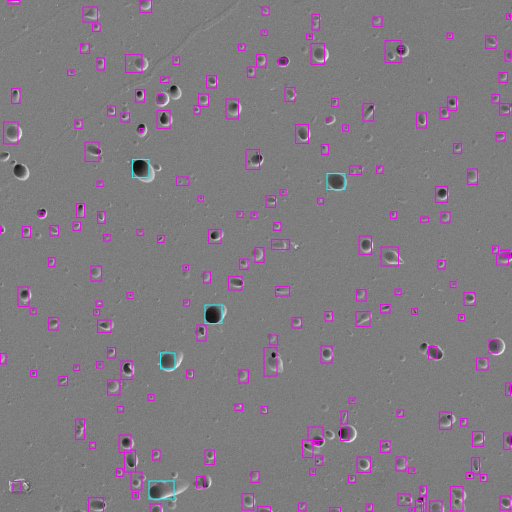
Counting tracks by eye does not scale, and fusion chips are rarely clean. BSI images the whole chip with SEM large-area mapping, captures thousands of tracks, and runs an AI classifier that labels each one.
- categoryParticle type. Alpha, proton-recoil and fission-fragment tracks are classified, not lumped together.
- speedEnergy estimate. From track diameter, length and morphology.
- filter_altSource versus noise. Genuine tracks are separated from polishing artifacts and surface contamination, which matters most when real signal is scarce.
- biotechEtch tuned to the target. NaOH concentration, temperature and time are optimized for your particle and energy range.
The method is described in our peer-reviewed paper on AI analysis of CR-39 with SEM large-area mapping.
Where It Fits
Typical fusion uses of CR-39
Laser-driven and inertial fusion
Filtered CR-39 stacks sample the proton and alpha spectra leaving a compressed target, a standard approach in charged-particle diagnostics.
Pulsed power and plasma focus
Shots that swamp electronics with EMP and X-rays leave a passive CR-39 chip untouched, with tracks that map where and how many particles arrived.
Fusors and neutron generators
Compact DD and DT sources can be mapped for fast-neutron and charged-particle output with a few low-cost chips placed around the device.
Lattice-confinement and LENR experiments
Low-yield deuterium-loaded targets, including metal deuterides from BSI, are often checked with CR-39. With few true tracks expected, AI source-versus-noise discrimination does the heavy lifting.
Honest Scope
When CR-39 is the right tool, and when it is not
Good fit
- Time-integrated counts and spectra of charged products
- Fast-neutron fluence mapping around a source
- Harsh EMP and X-ray environments where electronics fail
- Cheap, many-position coverage ($2/cm² for standard chips)
Pair it with something else
- Timing within a shot: add a time-resolved detector
- Real-time readout: chips must be etched and imaged after exposure
- Fuel and exhaust isotope accounting: use FT-ICR mass spectrometry for D, T, He-3 and HD
Questions & Answers
CR-39 for fusion FAQ
Can CR-39 be used as a fusion diagnostic?
Yes. CR-39 records charged particles such as the protons, alphas and tritons produced by fusion reactions, and it records fast neutrons indirectly through proton recoil in the polymer. It is passive, needs no power or electronics, and is not sensitive to X-rays, gamma rays or electromagnetic pulse, which makes it practical in harsh, noisy fusion environments.
What fusion products does CR-39 detect?
CR-39 directly records the charged products of DD fusion (a 3.0 MeV proton with a 1.0 MeV triton, or a 0.8 MeV helium-3), DT fusion (a 3.5 MeV alpha) and D-He3 fusion (a 14.7 MeV proton and a 3.6 MeV alpha). The neutrons from these reactions, 2.45 MeV for DD and 14.1 MeV for DT, are detected indirectly through proton-recoil tracks. BSI has recorded 14 MeV neutron-induced proton-recoil tracks in its CR-39.
Can CR-39 measure neutron yield from a fusion device?
CR-39 gives a time-integrated count of neutron-induced tracks, which can be related to total neutron fluence at the detector position. Converting that to a total yield depends on your geometry, source spectrum and shielding, so BSI works with you to match the method to your experiment before you order.
Why use AI track analysis for fusion experiments?
Fusion experiments often produce either very dense track fields or very few real tracks among surface defects. BSI's SEM large-area mapping captures thousands of tracks per chip and an AI classifier labels alpha, proton-recoil and fission-fragment tracks and separates genuine particle tracks from polishing artifacts and surface contamination. That source-versus-noise discrimination matters most when the true signal is small.
What are the limits of CR-39 for fusion diagnostics?
CR-39 is time-integrated: it records everything that arrives during exposure and cannot resolve when within a shot or run each particle arrived. Tracks must be chemically etched and read out after exposure, so it is not a real-time monitor. It is best paired with a time-resolved detector when timing matters.
How much does CR-39 for fusion experiments cost?
Standard CR-39 chips are $2 per square centimeter and boron-coated chips are $5 per square centimeter, with custom sizes available. Lead time is 3 to 14 business days depending on order type, and custom geometries are quoted individually. Exposed chips can be sent back to BSI for SEM and AI track analysis.
Tell us about your experiment
Send us your reaction, geometry and expected yield. We will recommend chip size, filtering and etch conditions, and quote detectors and track analysis together.